

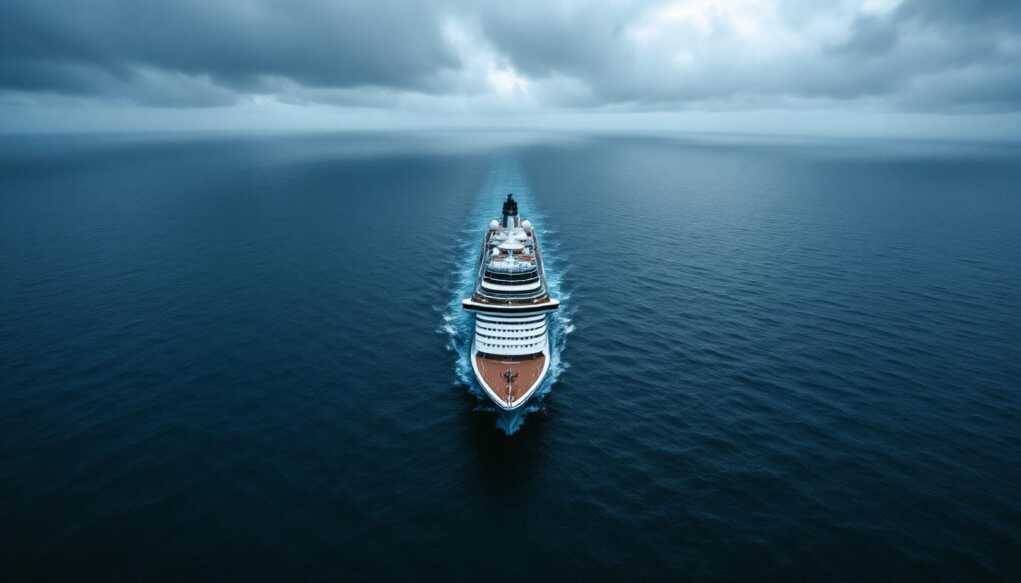
So there’s a luxury cruise ship called the MV Hondius currently floating around the Atlantic Ocean like a nautical leper colony, with 149 passengers and crew on board, three dead bodies in its wake, and a virus that kills roughly four out of every ten people it infects. And the World Health Organization — those paragons of early, decisive action — have assessed the global risk as “low.” Because if there’s one thing the WHO has proven over the past six years, it’s that their risk assessments are worth exactly what you paid for them.
Where have we heard THIS before? A deadly pathogen spreading on a vessel. International health authorities assuring everyone it’s totally fine. Countries refusing to let anyone dock. I’m getting flashbacks to early 2020, except this time the virus has a 40% kill rate instead of a 1% one, and the WHO is STILL telling us not to worry. These people could watch a mushroom cloud rise over the horizon and release a statement saying “the risk of nuclear annihilation remains low at this time.”
Here’s what happened. The MV Hondius — a luxury expedition cruise ship, because of course it is — set sail from Ushuaia, Argentina on April 1st. That’s the southernmost city in the world, the jumping-off point for Antarctic cruises popular with wealthy retirees who want to see penguins before they die. The ship sailed past Antarctica, the Falkland Islands, South Georgia, and a string of remote Atlantic islands. Sounds lovely. Postcard-worthy. Except somewhere along the way, passengers started dropping.
The first victim was a 70-year-old Dutch man who developed a fever, headache, abdominal pain, and diarrhea on board. On April 11th, he went into respiratory distress and died. His 69-year-old wife was evacuated to South Africa — where she collapsed at Johannesburg’s international airport and died on April 26th. She tested positive for a variant of hantavirus. Then on May 2nd, a German woman died on the ship. Her cause of death hasn’t been officially established yet, but everyone with a functioning brain knows what killed her.
As of today, there are seven known cases: two laboratory-confirmed hantavirus infections, five suspected. Three dead, one critically ill, three with “mild symptoms.” The ship limped toward Cape Verde on May 3rd, hoping to dock at the port of Praia. Cape Verde took one look at the floating petri dish and said “absolutely not.” Can’t blame them. The country’s health ministry said they needed to “protect the country’s public health.” Translation: we saw what happened to Italy in 2020 and we’re not doing that.
So now the ship is heading for the Canary Islands, because Spain — God bless them — apparently agreed to “welcome” the vessel. Welcome might be a strong word. More like “we drew the short straw and someone has to deal with this.”
Now let’s talk about what’s actually on this ship. Hantavirus. Not a household name like COVID or Ebola, but that’s what makes it scarier. This isn’t your garden-variety respiratory bug. Hantavirus pulmonary syndrome has a case fatality rate of roughly 38 to 40 percent. Read that number again. If ten people on that ship get sick, four of them are probably going to die. This isn’t the flu. This isn’t even COVID at its worst. This is the kind of virus that makes epidemiologists lose sleep.
Hantavirus is typically spread by rodents — through their droppings, urine, or saliva. You breathe in particles from infected rodent waste, you get sick, your lungs fill with fluid, and if you’re unlucky, that’s the ballgame. Human-to-human transmission has historically been considered extremely rare. Except — and here’s the fun part — the WHO now says that human-to-human transmission may have occurred on this ship. The Andes virus variant, which appears to be what we’re dealing with here, is the one strain of hantavirus where limited person-to-person spread has been documented before.
So we’ve got a virus that kills 40% of the people it infects, it might be spreading person to person on a confined ship, three people are already dead, and the WHO’s official position is “low risk to the global population.” Fantastic. Really inspiring confidence over there in Geneva.
Let’s be clear about something. We’re not saying this is the next pandemic. We’re not fear-mongering. What we ARE saying is that the people whose literal job it is to warn us about these things have a track record that would get them fired from any private sector job on the planet. These are the same geniuses who told us in January 2020 that there was “no clear evidence of human-to-human transmission” of COVID. The same organization that waited until the virus was on every continent before declaring a pandemic. The same bureaucrats who spent more time worrying about hurting China’s feelings than saving lives.
So when the WHO says “low risk,” what a normal person should hear is: “We genuinely have no idea what’s going to happen, but we’d rather not cause a panic because panics make us look bad.”
Meanwhile, 149 people are floating around the Atlantic on a ship that nobody wants, watching the ocean and wondering if the cough they just developed is a cold or a death sentence. The ship has been at sea for over a month. It’s sailed past Antarctica, across the entire Atlantic, and been turned away by Cape Verde. These passengers signed up for a luxury expedition. They got a horror movie.
And here’s the final kicker — the part that should make your blood boil. When those passengers finally do get off that ship, wherever that ends up being, they’re going to scatter to dozens of countries. The Hondius had passengers from the Netherlands, Germany, Canada, and who knows where else. Every single one of them is going to get on a plane and fly home. And we’re supposed to trust that the international health bureaucracy that fumbled COVID, monkeypox, and every other outbreak of the last decade is going to track every single one of them?
The WHO says the risk is low. The bodies say otherwise. And if history has taught us anything, it’s that by the time these people admit there’s a problem, the problem is already sitting in the seat next to you on your flight home.