

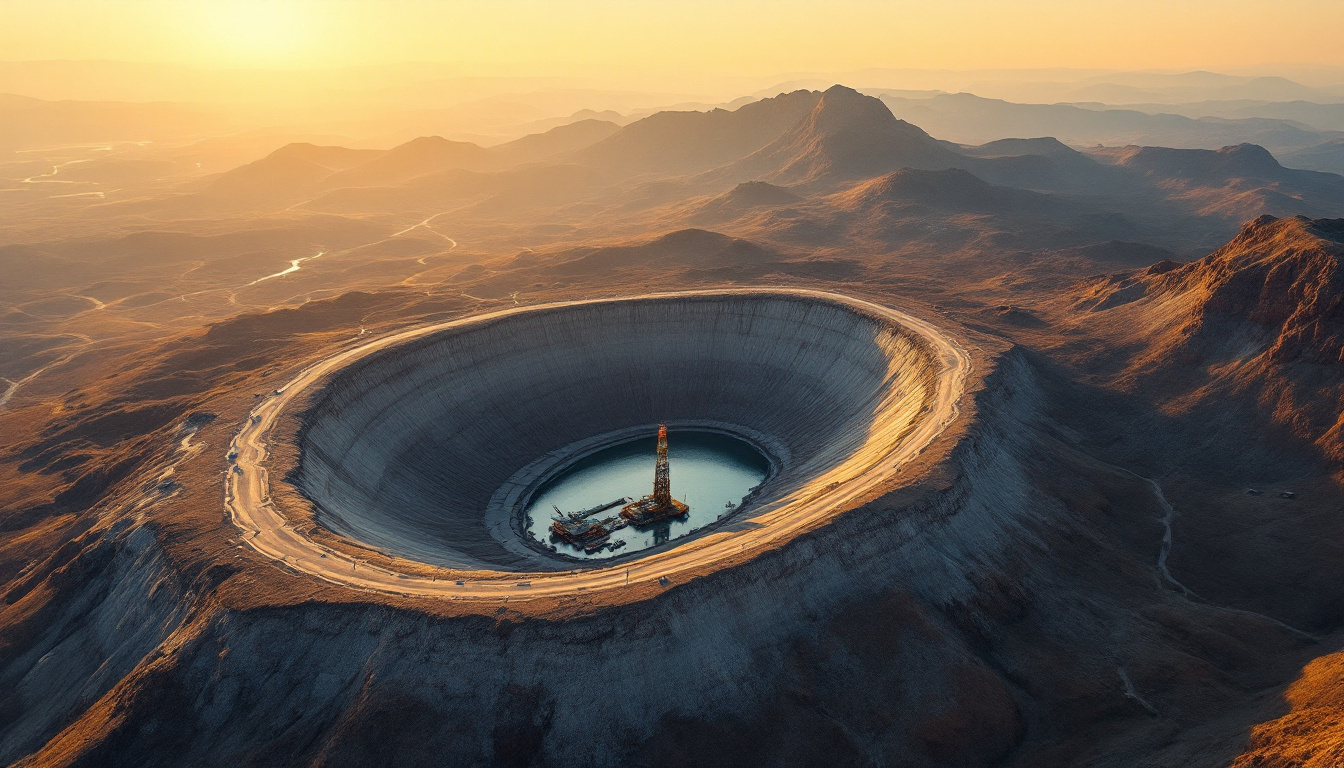
On the second day of drilling at the Durupınar Formation in eastern Turkey, the percussion core drill hit a layer four to five meters below the surface that was harder than limestone. The bit shattered.
Lauren Witzke, director of the Noah's Ark Research Project, wasn't hedging about what it means: "When we are done, university curriculums will need to be re-written, and Darwinism will be dismantled."
The Durupınar Formation near Mount Ararat is a 515-foot boat-shaped anomaly sitting at elevation in the exact region the Book of Genesis identifies as the resting place of Noah's Ark. Turkish Army Captain İlhan Durupınar first spotted it in aerial photographs in 1959. For the six decades since, the academic establishment treated the site the same way it treats most things that threaten its preferred narrative — with dismissal, bureaucratic obstruction, and the occasional condescending explainer about geological formations.
The 2026 expedition is different. Andrew Jones, founder of Noah's Ark Scans and Vice President of the Noah's Ark Research Project, is leading what's being described as the largest international permitted scientific expedition in the site's recorded history. The Turkish government authorized it. Sivas Cumhuriyet University is a formal partner. Prof. Dr. Cenker Atila is serving as president of the 2026 Research Project. Core drilling is reaching depths of up to 18 meters — roughly 60 feet — using a dry percussion system that doesn't contaminate samples. The last time anyone attempted drilling here was 1988, at a fraction of the current depth.
The preliminary data is already difficult to explain away. Dr. Khosrow Bakthar, a U.S. defense scientist, deployed his proprietary BaktharRadar at the site. His report found no bedrock beneath the formation — and subsurface readings showing internal structures, organized tunnels, and corridors with geometry that matches no known natural geological process. Geophysical surveys have mapped internal voids. The GOPHER drone — a custom underground exploration vehicle with high-resolution cameras — is being prepared to enter them.
Genesis 6:14 describes the Ark as built from gopher wood with three interior decks. The team has identified three subsurface layers matching that description and a 250-foot corridor inside the formation. The hard layer the drill struck at four to five meters is being tested for petrified wood.
Jones stated his position plainly: "I believe this is Noah's Ark, that's why I'm putting the Durupinar site through the most rigorous testing possible." The man most convinced of what the site is has been the loudest advocate for the hardest scientific scrutiny. That is the opposite of how the establishment handled it for 65 years — insisting the formation was meaningless without running a single comparable test.
For generations, the academic consensus treated Genesis as mythology — not as a scientific conclusion, but as a gate that kept certain questions from being asked with real equipment and real funding. The gate is being drilled through now, with government permits and university backing, and the data is heading to laboratories.
The core samples are in transit. The GOPHER drone is being prepped.
"Darwinism will be dismantled."
The drill bit is already in pieces.