
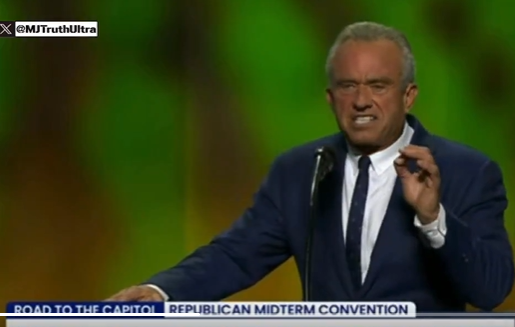
Robert F. Kennedy Jr. walked to the podium on Night 2 of the Republican Midterm Convention in Dallas and opened with a line that would've gotten him committed a decade ago: "I am 72. For 70 years of my life, I would've bet any amount of money that I would not be addressing a Republican convention."
Nobody in the arena laughed. Because nobody thought he was joking.
The HHS Secretary — a Kennedy, a lifelong Democrat by birth and lineage, the nephew of President John Kennedy and son of Robert Kennedy — then proceeded to deliver what's being called one of the standout speeches of the entire convention.
RFK Jr. didn't tiptoe around his defection. He went straight at the constitutional record of his former party, rattling off the First, Second, Fourth, Fifth, and Seventh Amendments and arguing the Democrats had gutted every one of them — with one exception.
"The only right they left unscathed was the Second Amendment," Kennedy said. "And probably because there is a Second Amendment."
That line landed in the arena like a brick through a window. The implication was surgical: the only constitutional protection Democrats haven't managed to erode is the one backed by 400 million firearms.
Kennedy then delivered the thesis of the speech in a single sentence: "It struck me that this was no longer about left and right. It was about sane and insane; it was about common sense and Communism."
He didn't stop there. Kennedy went after the 2024 Democratic primary process — or lack of one — with the line that drew the loudest reaction of the night. "They canceled their own Democratic Convention. No voter ever cast a primary ballot for Kamala Harris," he said. Then the hammer: "The party of NO KINGS simply ANOINTED A QUEEN!"
The crowd in Dallas lost it.
Kennedy also referenced the Butler, Pennsylvania, assassination attempt on President Trump, noting that Trump called him within three hours of nearly being killed. The detail sat there — no editorializing needed. A man who'd just survived a bullet picked up the phone and called a political rival. Whatever happened in that conversation, Kennedy ended up on a Republican stage.
Democratic operatives have spent two years trying to frame RFK Jr.'s departure as the wanderings of a conspiracy theorist who lost his way. That framing requires you to ignore his actual argument, which is that the party of civil liberties became the party of censorship, mandates, and coronation. Kennedy's rebuttal is simple: "In a single year, my party obliterated 250 years of constitutional guarantees."
That's not a conspiracy theory. It's a timeline.
The Kennedy name on a Republican convention stage isn't a novelty act. It's a data point. When someone whose family built the modern Democratic Party looks at what it's become and walks to the other podium, the question isn't why he left.
The question is what's left.