

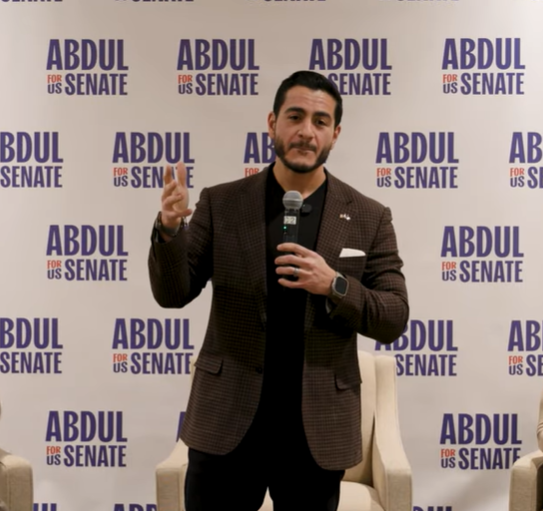
Abdul El-Sayed is running for the United States Senate in Michigan. The state that gave the world the assembly line, the Model T, and roughly 80% of the American auto industry. His big idea: treat automobiles like cigarettes.
Henry Ford built an empire in Detroit. El-Sayed wants warning labels on it.
The Michigan Senate candidate went public this week comparing cars to a public health menace, demanding that automobiles face the same kind of regulatory framework we use for tobacco products. Not electric vehicles specifically. Not commercial trucks. Cars. The thing Michigan makes. The thing that employs hundreds of thousands of people across the state, from the factory floors of Detroit to the parts suppliers in Grand Rapids and Lansing.
Consider the political math for a moment for a candidate who publicly acknowledges wanting to destroy the economy of the state he represents. Michigan's auto industry supports over a million jobs statewide when you count the full supply chain — manufacturing, logistics, dealerships, parts. The Big Three — Ford, General Motors, and Stellantis — still call Michigan home. The state's identity is so wrapped up in the automobile that its largest city is literally nicknamed the Motor City. And this is where El-Sayed decided to wage war on cars.
It's the political equivalent of running for Senate in Idaho and announcing a crusade against potatoes. Or campaigning in Wisconsin on an anti-cheese platform. You don't have to be a political strategist to spot the problem.
The cigarette comparison is doing a lot of heavy lifting here. Cigarettes are taxed at punitive rates specifically designed to discourage use. They carry mandatory health warnings. They're banned from advertising on television. They can't be sold to anyone under 21. They're prohibited in restaurants, bars, offices, and most public buildings. That's the regulatory model El-Sayed wants applied to the product his state builds.
So what does that look like in practice? Warning labels on your F-150? Sin taxes on a Chevy Silverado? Banning car commercials during football games? He hasn't spelled out the specifics — which is its own kind of tell. When a politician reaches for the most extreme analogy available and then refuses to detail what it means in policy terms, the analogy isn't an argument. It's a bumper sticker for people who already agree with him.
The Democrats who push this kind of agenda always frame it as "public health." That's the magic phrase that turns any policy preference into a moral emergency. Guns are a public health crisis. Obesity is a public health crisis. Now cars are a public health crisis. The list of things that aren't a public health crisis to these people is shorter than the list of things that are.
Meanwhile, the actual public health data on automobiles tells a different story than the one El-Sayed is selling. Vehicle fatality rates per mile driven have dropped steadily for decades. Modern cars are safer, cleaner, and more efficient than anything Ford or GM ever put on the road in the 20th century. If cars were cigarettes, they'd be cigarettes that got 90% less dangerous over fifty years while the government kept demanding more restrictions.
Michigan voters don't need a Senate candidate who looks at the backbone of their state's economy and sees a carcinogen. They need one who understands that the auto industry isn't a disease to be regulated out of existence — it's the reason their state exists in the form it does.
El-Sayed is running in a 2026 midterm cycle where the economy is the top issue for voters in every poll. His answer to that concern is to compare their jobs to cancer sticks.
The filing deadline hasn't closed the race yet. But the auto workers in Dearborn already know where they stand with this candidate.