

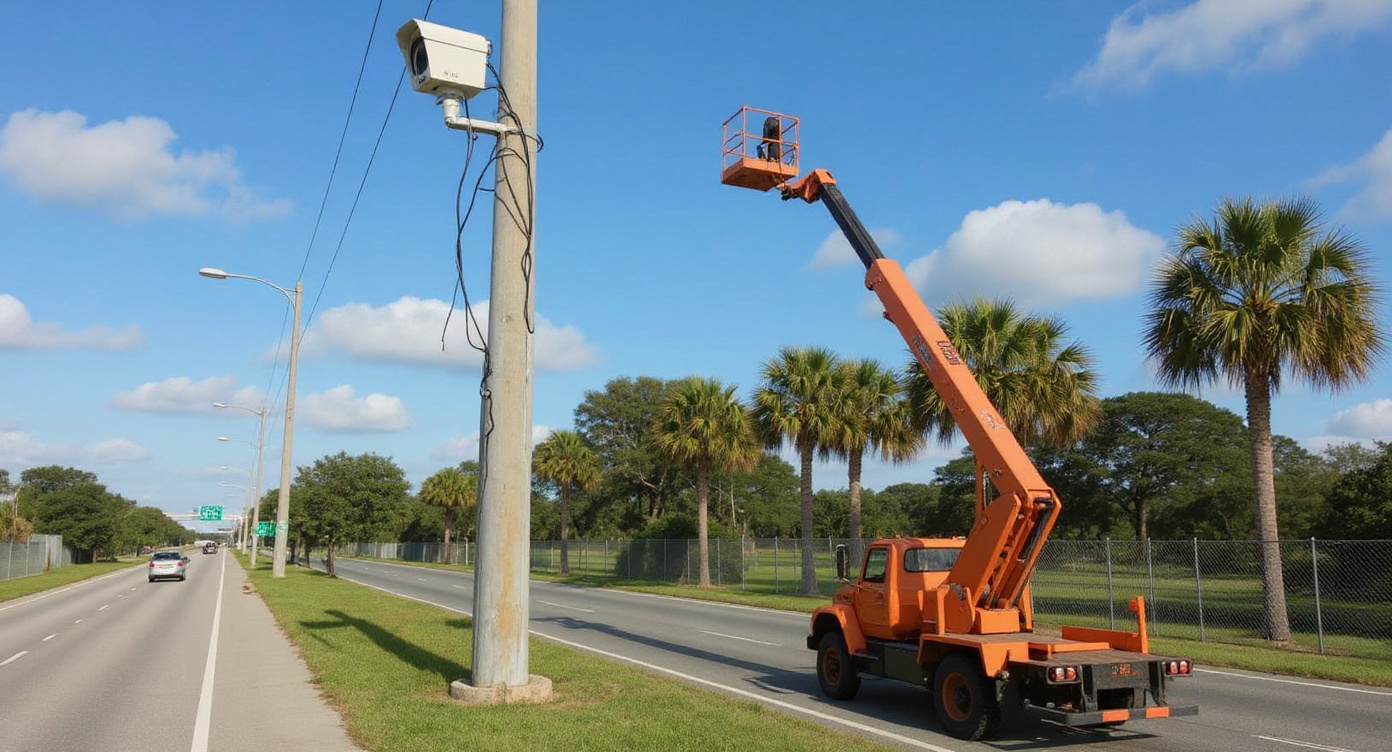
There are roughly 7,500 Flock license-plate reader cameras scattered across Florida, quietly logging where you drive, when you drive, and how often you drive there. As of this week, every single one of them sitting on a state highway right-of-way has 30 days to come down.
Governor Ron DeSantis just made the call.
The Florida Department of Transportation issued the order through FDOT Chief Operating Officer Will Watts, P.E., citing an "exponential increase" in camera deployments, mounting reports of misuse, data privacy concerns, and what the agency memo called outright "surveillance schemes." The directive is clear: remove the Flock cameras from State Highway System rights-of-way within 30 days, or FDOT will remove them for you. The extended deadline stretches to late September at the latest.
DeSantis confirmed the order himself in an appearance with Eric Bolling, putting it plainly: "We're going to clear the state right-of-ways."
The FDOT memo frames the purpose in language you don't hear from government agencies very often — "to preserve Floridians' sovereignty and quality of life." That's the state transportation department talking about sovereignty. Not safety metrics. Not traffic flow optimization. Sovereignty.
Now, let's be precise about the scope. This order covers state roads — the highways FDOT controls. County roads, city streets, and private property are outside the directive. Florida Highway Patrol also retains its mobile license-plate readers for active law enforcement. So this isn't the abolition of all plate-reading technology in Florida. It's the dismantling of a passive, always-on surveillance grid bolted to state infrastructure.
The distinction matters because it answers the predictable objection. "But what about catching criminals?" Law enforcement keeps its tools. What gets yanked is the 24/7 bulk collection apparatus that treats every commuter like a suspect.
Meanwhile, blue-state governors are moving in the opposite direction — expanding camera networks, adding facial recognition layers, building the kind of infrastructure that would make a Stasi officer blush. New York has its ring of steel. California never met a surveillance program it didn't want to fund. The trend line in progressive America points toward more cameras, more data collection, more government awareness of where you go and what you do.
Florida just reversed course at highway speed.
The order represents one of the most concrete privacy actions taken by any governor this year. Not a press conference about principles. Not a bill that might pass next session. A 30-day countdown on 7,500 cameras.
There's a reason people keep moving to Florida, and it's not just the weather. When your governor's instinct is to tear down surveillance infrastructure instead of build more of it, that tells you something about which direction the state is pointed.