
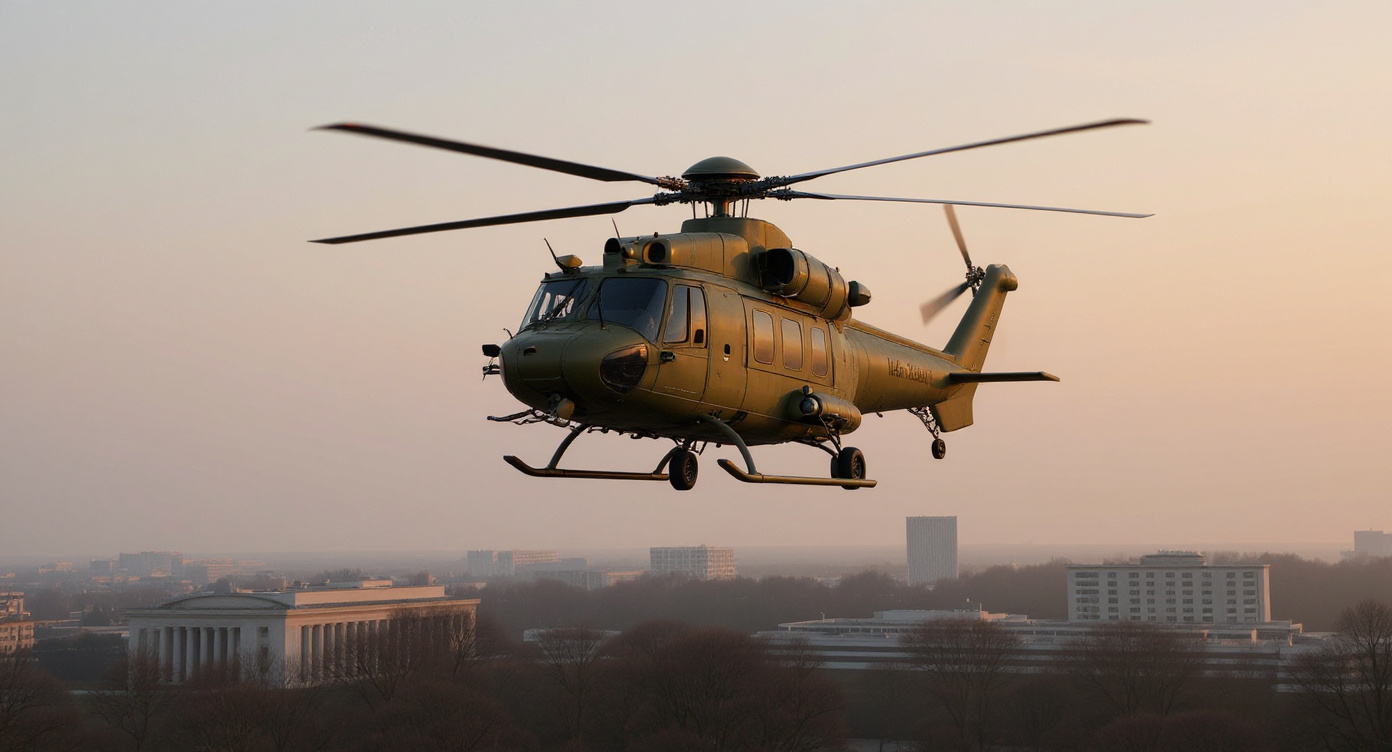
Marine One lifted off from the White House on Tuesday afternoon carrying President Trump. Air traffic controllers at Ronald Reagan Washington National Airport had not placed the required hold on commercial flights. The mandatory 1.5-mile horizontal separation and 500-foot vertical buffer that federal rules demand in that airspace? Nobody had checked.
The Federal Aviation Administration confirmed it is looking into the incident, releasing a statement that read, "The FAA is investigating a safety incident involving Marine One, but it didn't appear to be a dangerous close call and the aircraft weren't apparently converging." The key detail: controllers typically expect Marine One to provide at least three minutes of advance notice before takeoff — a protocol that may not have been followed.
So we have a helicopter carrying the President of the United States departing into airspace shared with commercial jets, and the people whose only job is to keep aircraft from colliding didn't activate the standard hold procedures. The system designed specifically to prevent catastrophe just... didn't engage.
This would be concerning enough on its own. But context makes it worse.
In 2025, a U.S. Army Black Hawk helicopter collided midair with an American Airlines regional jet near the same airport. People died. The FAA responded by establishing new restrictions governing helicopter and airplane traffic around Reagan National to make sure it never happened again.
Tuesday's incident suggests those procedures exist on paper and not necessarily in practice.
Now, to be clear — the FAA's own statement says the aircraft weren't converging and the situation didn't appear dangerous. We're not talking about a near-miss. We're talking about a protocol failure. The three-minute advance warning, the commercial hold, the separation requirements — these aren't suggestions. They're the direct result of people dying in that same airspace. And someone, somewhere in the chain, either didn't communicate or didn't execute.
Some will try to frame this as a Trump problem, as though the President personally coordinates his helicopter's departure with Reagan National tower. He doesn't. Marine One operations involve military flight crews, Secret Service logistics, and FAA coordination. If the three-minute notice wasn't given, that's a communication breakdown between military aviation and civilian air traffic control. If the notice was given and controllers didn't act on it, that's an FAA execution failure. Either way, it's a system problem — the kind of system problem that post-crash reforms were supposed to eliminate.
The uncomfortable question isn't whether Tuesday was dangerous. The FAA says it wasn't. The uncomfortable question is what happens when the same procedural lapse occurs on a day when an American Airlines regional jet is on short final into Reagan at the wrong moment. We already know the answer to that question. We learned it in 2025.
Government has a reliable pattern when it comes to safety failures. Tragedy happens. Commissions are formed. Reports are written. Rules are created. Press conferences are held. And then, slowly, quietly, the urgency fades. The new protocols become routine. Routine becomes complacency. Complacency becomes the next incident. The cycle doesn't break because the people who write the rules and the people who follow the rules are separated by layers of bureaucracy thick enough to muffle any alarm.
The FAA wrote those post-crash restrictions because the status quo killed people. Tuesday proved the new status quo might not be much different from the old one.
That's not a close call. That's a warning.