
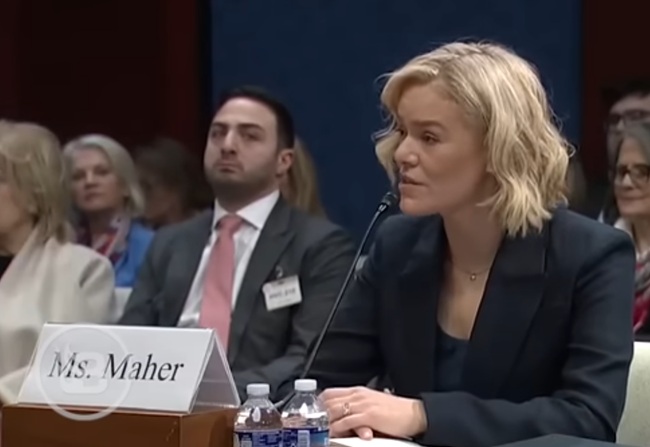
On March 26, 2025, Rep. Brandon Gill read Katherine Maher's own tweet back to her: "Yes, the North, yes all of us, yes America. Yes, our original collective sin and unpaid debt. Yes, reparations. Yes, on this day." Then he asked the NPR CEO if she believes white people should pay reparations. "I have never said that, sir," Maher replied.
She'd said exactly that. In writing. On a platform that archives everything.
The House Delivering on Government Efficiency subcommittee hearing was supposed to be about public broadcasting bias. It turned into something more useful — a real-time demonstration of how Washington's professional class handles accountability. Gill, a freshman Republican from Texas, came with documentation. Maher came with a five-word escape hatch: "My thinking has evolved since then."
That escape hatch got a workout. When Gill asked about a May 2020 tweet in which Maher wrote that it's "hard to be mad about protests not prioritizing the private property of a system of oppression founded on treating people's ancestors as private property" — a fancy way of excusing looting — she acknowledged it but insisted her views had changed. When he asked about a tweet claiming America was "addicted to white supremacy," same answer. Evolved. When confronted with a January 2020 post about Ta-Nehisi Coates' "The Case for Reparations," Maher tried a different move. "I don't think I've ever read that book, sir."
Her own tweet said she took a day off to read it.
Archivists had catalogued 29,400 tweets from Maher's account. Congress didn't need all of them. The handful Gill selected painted a clear enough picture: a November 2, 2020 post about wearing a "Biden President" hat and mask during voter outreach. The looting defense. The reparations endorsement. The white supremacy diagnosis. Each one written by the woman who runs a taxpayer-funded news organization that receives $120 million-plus annually and claims to deliver "unbiased, nonpartisan, fact-based reporting to Americans."
DOGE Committee Chairwoman Marjorie Taylor Greene noted that 77 million Americans voted for Trump. NPR's Washington headquarters, as documented by former senior editor Uri Berliner before his departure, employed 87 registered Democrats among its editorial staff. Registered Republicans: zero. Berliner's reward for reporting this was a suspension and public humiliation. Maher called his concerns "profoundly disrespectful, hurtful, and demeaning."
The First Amendment, in Maher's previous telling, is the "number one challenge" that makes it "tricky" to modify content the way she'd prefer. She's also on record saying "our reverence for the truth might be a distraction" from getting things done. Under her leadership, NPR changed its longstanding rules barring journalists from joining political protests.
So naturally, on October 26, 2026, Harper's Magazine handed her the James C. Goodale First Amendment Award at The Morgan Library & Museum in New York City. The award, as Conservative Review's Jeannie DeAngelis reported, recognizes individuals who have demonstrated "a clear and consequential commitment to the principles of a free press and its constitutional protections." It's named for the former general counsel of the New York Times who defended the paper's right to publish the Pentagon Papers.
The woman who called the First Amendment a challenge to censorship now has a First Amendment trophy on her shelf. The woman who couldn't recall her own tweets under oath is being celebrated for her commitment to transparency. The woman who ran a newsroom with 87 Democrats and zero Republicans is the face of press freedom.
The award was presented by Leila Fadel, NPR host of "Morning Edition." The audience applauded.