

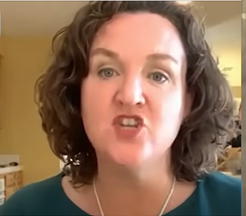
Katie Porter — the former California congresswoman who once led polls in the governor's race — finished fifth in the primary. Now she's announced she's leaving politics entirely and launching an Instagram account called Katie Porter Turns The Page dedicated to book reviews.
The whiteboard queen found a new prop.
Porter told followers, "I'm done for now with politics and campaigning." The "for now" is doing a lot of work in that sentence, but given that she just got beaten by four other candidates in a state where she spent years building a brand as the progressive fighter who'd hold anyone's feet to the fire, it's hard to imagine what comeback scenario she's envisioning.
The reactions were roughly what you'd expect. "Finally, some good news," wrote one commenter. Another offered the more precise observation: "Politics is done with Katie Porter." That second one lands closer to the truth.
The California gubernatorial primary was supposed to be Porter's coronation. She'd built a national profile through viral committee hearing clips — the whiteboard, the tweeted takedowns, the performative outrage at corporate executives who couldn't answer her questions fast enough. Progressive media treated her like a star. The fundraising followed. The poll numbers, at least early on, confirmed the theory.
Then the campaign actually started. Reports of explosive outbursts and abrasive treatment of staff surfaced. An incident involving aggressive behavior toward a CBS journalist didn't help. The same intensity that made for good three-minute hearing clips turned out to be less appealing when voters had to imagine it running the fifth-largest economy in the world for four years.
The comparison to Tim Walz floated around social media, and it's not unflattering to either of them. Both built brands on a specific kind of performative populism — the teacher who talks tough, the professor who brings props. Both discovered that the gap between "people love my clips" and "people want me in charge" is wider than a TikTok algorithm suggests.
Porter's pivot to book content is interesting mostly for what it reveals about the theory of progressive celebrity politics. The assumption has always been that national media attention converts directly into electoral power — that if enough people know your name and like your style, the votes follow. Porter had the name recognition. She had the clip reel. She had Whoopi Goldberg defending her on national television.
The progressive bench has a pattern now. Big personalities. Massive social media followings. Enthusiastic coverage from sympathetic outlets. And then the primary results come in and the candidate who actually did the unglamorous work of building coalitions and showing up to local events walks away with it.
Porter isn't the first progressive star to discover that Twitter followers don't vote in California primaries. She probably won't be the last. The incentive structure that rewards viral moments over constituent services hasn't changed.
She's reviewing books now. Given how the campaign went, fiction might be a natural fit.