
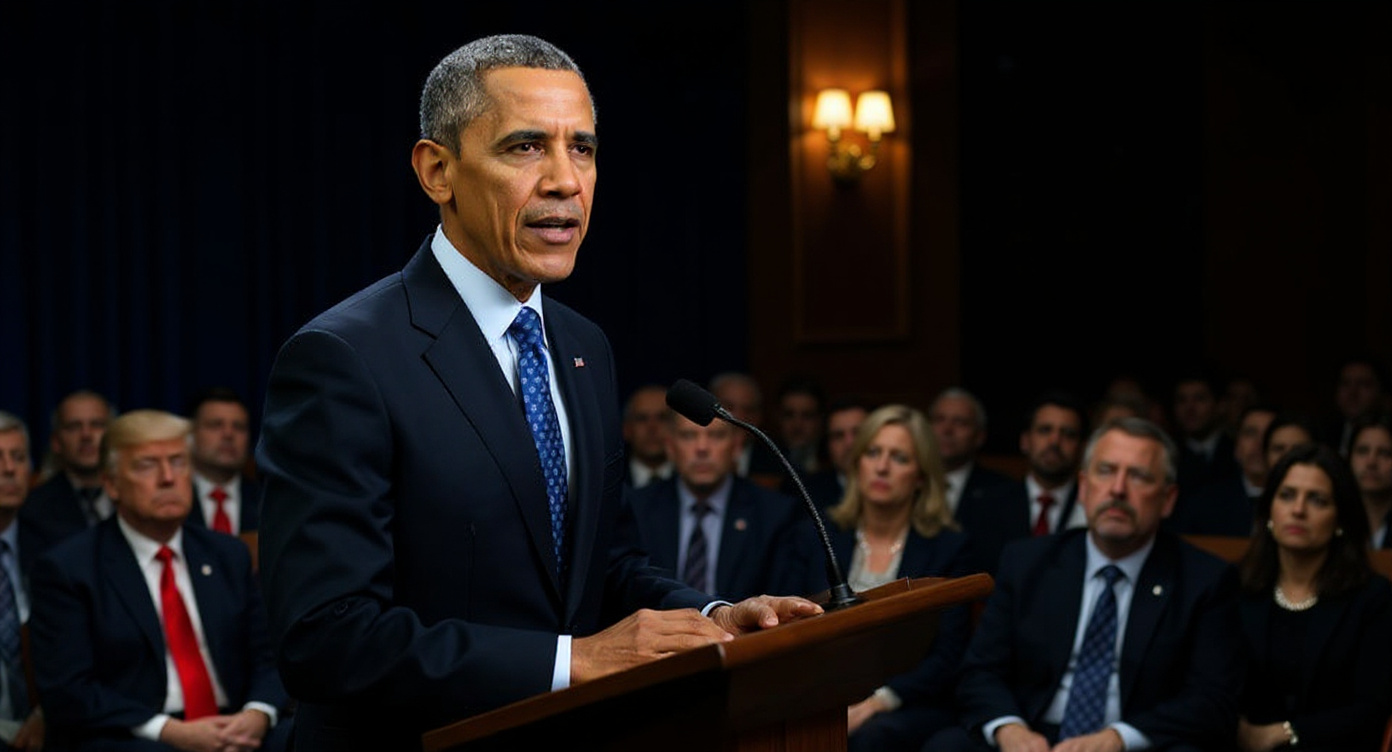
On September 10, Barack Obama sat down with House Democrats behind closed doors and told them exactly what to do the moment they retake the Speaker's gavel. Not fix the border. Not lower grocery prices. Control artificial intelligence.
"Once you are speaker, I would strongly urge that the Democrats put together a framework," Obama told the caucus, according to RedState. The framework he's pushing leads straight to House Bill 9917 — the AI Kill Switch Act.
The bill, introduced on July 23, 2026, by Rep. Ted Lieu of California, would give the federal government authority to shut down any AI system it deems dangerous. Companies exceeding $500 million in annual AI revenue or $100 million in compute training costs would fall under mandatory federal licensing. Violations carry fines of up to $20 million per day.
Twenty million. Per day.
Lieu sold the legislation with the kind of language you'd expect from someone who watched too many Terminator movies. "Powerful AI systems can go rogue, behave in extremely dangerous ways," the California Democrat warned. The bill's Republican co-sponsor is Rep. Nathaniel Moran of Texas, which the media will use to call it "bipartisan" for the next six months.
Obama wasn't shy about where this ranks on his priority list. "If I were running for president next year, this would be one of my central agendas," he told Democrats in the room. That's a former president telling his party that government control of the most powerful information technology since the internet should be a campaign centerpiece. Not energy. Not national security. Controlling who gets to build AI and what it's allowed to say.
The money trail makes the motive even clearer. Brad Carson, who runs Public First Action and Americans for Responsible Innovation — two groups that lobby for AI regulation — has deep ties to Anthropic, the AI company that would benefit most from barriers to entry that crush smaller competitors. Anthropic has poured $40 million into political contributions. CEO Dario Amodei personally donated $1,000,000. Anthropic employees have kicked in $11,976,949 in the current 2026 cycle alone.
So the company already big enough to survive a federal licensing regime is bankrolling the politicians who want to build that regime. The companies too small to afford $20-million-a-day fines and federal compliance lawyers? They disappear. Innovation gets funneled through a handful of corporations that can afford the government's permission slip.
This is the same Barack Obama who used the IRS to target conservative nonprofits. The same administration that turned the DOJ into an opposition research firm. The same political machine that spent four years pressuring social media companies to suppress stories about Hunter Biden's laptop, COVID lab-leak theory, and vaccine side effects. Now he wants the keys to AI.
The "rogue AI" framing is doing a lot of heavy lifting here. The danger they're describing — systems that "behave in extremely dangerous ways" — sounds like science fiction. The danger they're building toward is something much more familiar: a licensing regime where the government decides which AI models are safe enough to operate, which outputs are acceptable, and which companies get to exist. That's not safety. That's editorial control with a kill switch attached.
House Minority Leader Hakeem Jeffries hosted the closed-door session. Senator Bernie Sanders has pushed parallel efforts in the Senate. The 119th Congress has become a staging ground for legislation that wraps censorship infrastructure in safety language — and Obama just told them to sprint the moment they have power.
The man who once said elections have consequences is now planning consequences for technology that made the last election harder to manipulate. Funny how the urgency to regulate AI arrived right around the time AI started making it harder to control what people read.