

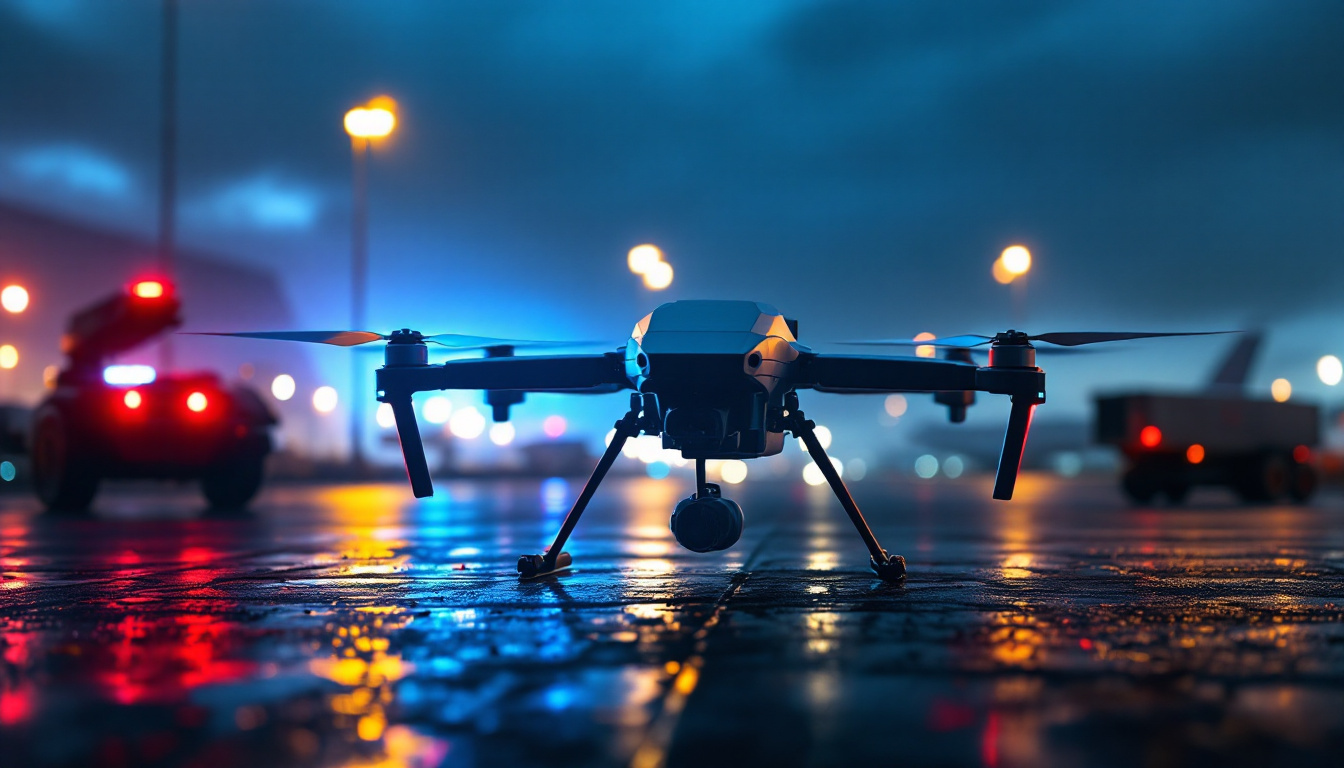
A new form of terrorism has arrived in the heart of Europe. Russia spent years perfecting it on Ukrainian soil — attaching explosives to cheap commercial drones and sending them after soldiers, civilians, and infrastructure — and last week it showed up at a German airport.
On the night of August 4th, a bus driver at Leipzig/Halle Airport walked up to a hovering quadcopter drone, grabbed it with his hands, and discovered it was packed with military-grade Semtex, a detonator, and an unidentified secondary substance. He had found it near the south runway, floating at low altitude beside a row of parked Ukrainian Antonov cargo planes.
The detonator malfunctioned. That's it. That's what stood between a German freight hub and a fireball.
The attack didn't stop there. Shortly before midnight, airport personnel spotted an unidentified flying object near the runway. Then a second presumed drone collided mid-air with a DHL cargo jet, causing nosecone damage and forcing it to divert 200 kilometers to Hannover Airport. Then a third unknown object was found sitting on the southern runway.
Three vectors. One airport. One night.
Leipzig/Halle isn't chosen at random. It's the primary European logistics hub funneling military equipment and supplies to Ukraine through NATO's Strategic Airlift International Solution — SALIS — the program that uses Ukrainian Antonov An-124 cargo aircraft to move hardware reinforcing NATO's eastern flank. Moscow knows exactly what moves through that airport. It has been trying to stop it since 2024, when an incendiary device detonated at the same facility and set fire to a freight container — an attack Western security officials attributed to Russian intelligence.
Same airport. Same Russian fingerprints. The attacks didn't stop — they escalated.
Ukraine's ambassador to Germany put it plainly: "Who else could it be besides Russia? Russia has been waging this 'hybrid war' for a long time." German Interior Minister Alexander Dobrindt, who cut his vacation short to manage the response, called it "a new quality of danger" and "a new threat scenario." German police recorded over 1,000 suspicious drone flights across the country in 2025 alone.
The weapon itself is what demands attention. A commercial quadcopter costs a few hundred dollars. The Semtex packed into this one was military-grade. The infrastructure it nearly destroyed — two active runways, multiple cargo aircraft, a NATO logistics operation — is worth hundreds of millions. That gap between the cost of the weapon and the cost of the target is the entire strategy. Cheap. Deniable. Nearly invisible to conventional radar.
That's the template Russia handed the world. Other countries noticed.
In February 2026, the FBI warned of a credible Iranian plot to launch drone attacks from an unidentified vessel off the California coast. Iran has demonstrated drone capability with a range exceeding 1,200 miles. Iranian proxies have used armed drones against U.S. allies and assets across the Middle East for years. Counterterrorism officials have warned that Iranian sleeper cells operating on U.S. soil represent a credible near-term threat — and the Leipzig playbook is exactly the kind of operation those cells could attempt to replicate.
A commercial drone. Military explosives. An airport. A power grid. A crowded port. The target almost doesn't matter. What matters is that a $300 device can shut down a major airport, destroy a cargo aircraft, and expose every vulnerability in a country's security posture simultaneously.
Germany's response has been to issue statements. Dobrindt acknowledged that "drone sightings, drone threats including in a hybrid context, are something we know from the past." Which raises the obvious question: if you knew about it, why was a bus driver the last line of defense between a Semtex-packed quadcopter and a runway full of aircraft?
A bomb-defusing robot eventually removed the detonator. A bus driver found the bomb.
That's not a security plan. That's a coin flip.