

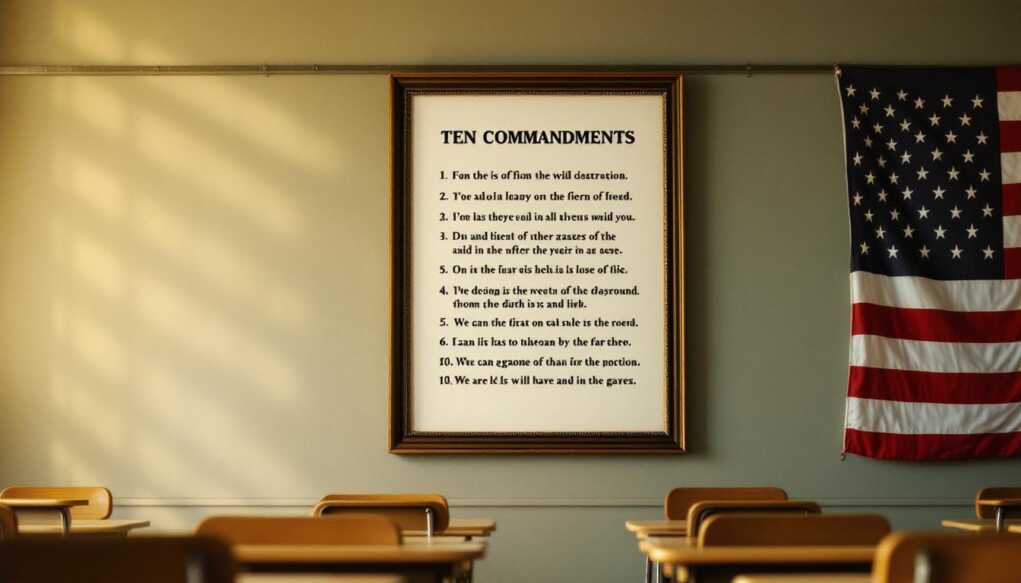
We’ve been saying it for years: if you want to win the culture war, you actually have to show up and fight it. Not tweet about it. Not write a strongly worded letter to your congressman. Pass a law, defend the law, and let the courts sort it out. Texas did exactly that — Governor Abbott signed legislation requiring the Ten Commandments to be displayed in public school classrooms, and when the inevitable army of ACLU lawyers and activist groups came shrieking about “separation of church and state,” a court looked at the case, looked at the Constitution, and said: nah, this stands.
You could hear the collective gasp from every faculty lounge in Brooklyn. Somewhere, a blue-haired professor just spilled her oat milk latte on a copy of *The God Delusion.* This is what happens when a state government actually has a spine — and a judiciary that reads the Constitution instead of making it up as they go along.
Let’s back up for a second, because the left wants you to think this was some sort of radical, unprecedented, theocratic power grab. It wasn’t. The Ten Commandments have been part of American public life since before there was an America. They’re carved into the Supreme Court building, for crying out loud. Moses is literally staring down at the justices from the wall. Nobody’s suing to sandblast him off. But put “Thou Shalt Not Steal” on a classroom wall in Houston, and suddenly we’re five minutes away from a handmaid’s tale? Give me a break.
The law is straightforward. Texas HB 1605 requires public school classrooms to display a poster-sized copy of the Ten Commandments. The state argued — correctly — that the Commandments are a foundational document in Western legal tradition, not a Sunday school lesson plan. Nobody’s forcing kids to kneel. Nobody’s making them recite Deuteronomy before lunch. It’s a poster. On a wall. In a state that already lets teachers carry guns. The priorities of the opposition here tell you everything you need to know.
And oh, the opposition showed up in force. The usual suspects — the ACLU, Americans United for Separation of Church and State, a grab bag of activist parents who probably couldn’t name three of the Commandments if you spotted them “Thou Shalt Not” — they all filed suit. They threw everything at the wall. Establishment Clause violations, coercion claims, the whole playbook. They argued that a child seeing the words “Honor thy father and thy mother” on a classroom wall was somehow an act of government-imposed religion.
The court didn’t buy it. Not even a little.
The ruling acknowledged what any honest legal scholar already knows: the Ten Commandments have a dual nature. Yes, they’re religious. They’re also historical, legal, and cultural. The Supreme Court has recognized this going back decades. The Commandments aren’t just a religious text — they’re the foundation of the legal code that built Western civilization. “Thou shalt not kill” isn’t a controversial theological position. It’s literally the law. If you can’t handle seeing it on a wall, the problem isn’t the wall.
Now here’s what makes this ruling beautiful. It didn’t just survive a challenge — it survived the *exact kind* of challenge that has been used for forty years to strip every last trace of religious heritage from public spaces. The left has been running the same play since the 1980s: find a cross, find a nativity scene, find a plaque with a Bible verse, sue it into oblivion, and then lecture the rest of us about “tolerance.” That play just hit a brick wall in Texas. A big, beautiful, Ten Commandments-shaped brick wall.
Governor Abbott — and credit where it’s due, the man doesn’t flinch — called the ruling a victory for religious liberty and parental rights. He’s right. But it’s bigger than that. This is a victory for the basic idea that America doesn’t have to be embarrassed about its own heritage. We don’t have to pretend the Founders were a bunch of secular humanists who just happened to reference God in every founding document they wrote. We don’t have to erase three thousand years of moral philosophy because it makes a handful of activist lawyers uncomfortable.
The left is already promising to appeal. Of course they are. They’ll take it to the Fifth Circuit, and if they lose there, they’ll try to get it to the Supreme Court. Good luck with that. This is the same Supreme Court that overturned *Roe*, ended affirmative action, and told the EPA to stay in its lane. If the ACLU thinks *this* court is going to strike down a Ten Commandments display in Texas, they’re smoking something stronger than what they legalized in Colorado.
Here’s the bottom line, and it’s simple: Texas showed every red state in America how this is done. You pass the law. You defend the law. You don’t apologize. You don’t water it down. You don’t pre-compromise because you’re afraid of what the *New York Times* editorial board might say. You plant your flag and you dare them to come take it.
And when they came? The court told them to go home.
That’s not theocracy. That’s democracy. That’s a state legislature passing a law that its citizens support, and a court confirming that the Constitution allows it. If the left doesn’t like it, they’re welcome to pass their own laws in their own states. Maybe California can mandate a poster of the Communist Manifesto in every classroom. At least then they’d be honest about what they’re teaching.
The Ten Commandments are back in Texas classrooms. The court said it’s fine. And somewhere in Austin, a kid is going to look up at that poster, read “Thou shalt not bear false witness,” and learn something that CNN never could have taught him.
We’ll call that a win.