

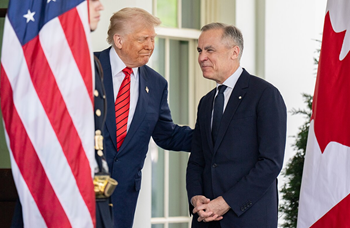
Canada currently owns 2,000 military drones. Prime Minister Mark Carney wants more — a lot more — and he's calling it the "largest defense rearmament in 70 years." Not because Canada faces an invasion. Because the country sitting directly below the border keeps winning trade negotiations, and Ottawa ran out of leverage sometime around March.
Meanwhile, the first ministers of Scotland, Wales, and Northern Ireland are reportedly meeting to discuss fracturing the United Kingdom into pieces. And European central banks just raised rates in what looks a lot like a coordinated squeeze on the Federal Reserve.
All of this in the same week. All of it pointed at the same target.
Britain's Net Zero energy policies have locked the country out of its own North Sea oil reserves — reserves that could make the UK energy-independent overnight. President Trump pointed this out directly: "The capital of European oil was in Aberdeen... could be again. If they open North Sea, UK rich. If not, UK bankrupt." Instead of drilling, the political class is using Brexit divisions to shift power back toward Brussels, while regional leaders talk openly about dissolution.
That's not an energy policy. That's a controlled demolition.
North of us, Carney isn't being subtle about what the drone buildup means. "Drones will be at the forefront of mission to build Canada strong, safe, secure," he told reporters, borrowing the kind of language countries use when they're preparing for something they don't want to name out loud. Canada's Industry Minister Mélanie Joly was more direct about the economic side of the strategy. She confirmed Ottawa is targeting specific American state exports in trade talks, saying, "We are putting pressure clearly on different states and people."
Specific states. Specific people. That's not a tariff negotiation. That's a political operation designed to create pain in districts that vote a certain way before November's midterm elections.
The trade talks themselves collapsed Friday night at 10 PM with what officials described as "new demands" — the kind of last-minute poison pill you drop when you never wanted a deal in the first place. You wanted the headlines about a deal falling apart.
Then there's the financial angle. European central banks raised interest rates in a move that several analysts have described as an attempt to pressure the Federal Reserve into following suit. Higher rates before midterms would slow the economy, spike borrowing costs, and give every cable news panel a reason to say the word "recession" fourteen times an hour.
Treasury Secretary Scott Bessent wasn't buying it. "Bunch of noise," he said. "Made money ignoring it." Which is the kind of thing you say when you've seen the playbook before and you know what chapter they're on.
The playbook isn't complicated. When you can't beat the policy, you create enough simultaneous crises that voters blame the guy in charge. Fracture a key ally so the "special relationship" becomes a liability instead of an asset. Arm a neighbor and aim its trade policy at swing-state industries. Manipulate interest rates to manufacture economic anxiety sixty days before an election.
None of these moves make their own countries stronger. Net Zero doesn't make Britain richer. A drone fleet doesn't feed Canadians. Rate hikes don't help European consumers. Every single play sacrifices domestic prosperity to score points against Washington.
That's the part that gives it away. Countries acting in their own interest make different choices than countries acting against someone else's. And right now, a half-dozen governments are making choices that hurt their own citizens but conveniently create problems for one American president.
Bessent's response might be the most instructive detail in the whole story. He didn't panic. He didn't call emergency meetings. He called it noise. When the Treasury Secretary treats a coordinated international pressure campaign like background static, it tells you something about how much leverage these moves actually have.
The midterms are eight weeks out. The economy is growing. Energy production is up. The border numbers are down. So the only play left is to manufacture enough chaos overseas that the good news at home gets drowned out.
Eight weeks is a long time to keep pulling fire alarms when nothing is actually burning.