

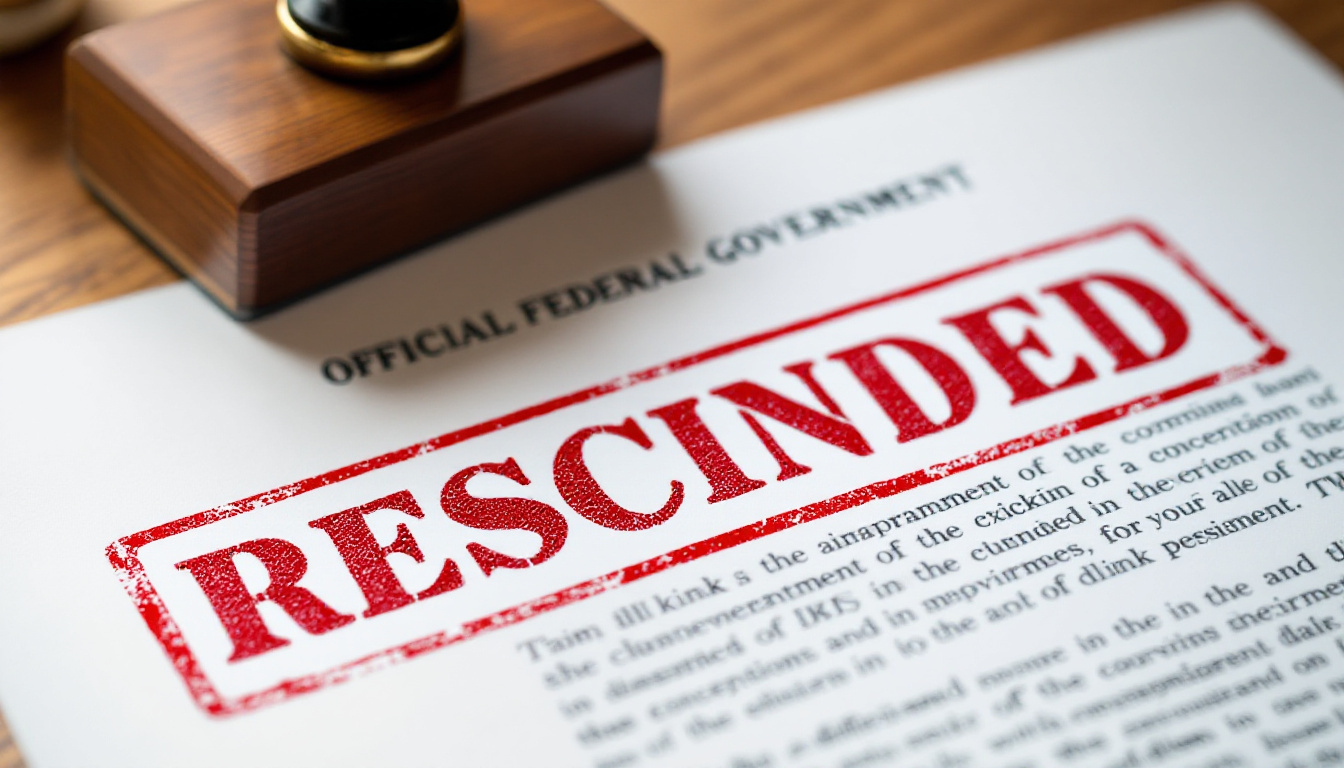
For 47 years, the federal government could investigate your kid's school for discrimination without evidence that anyone actually discriminated. All it took was a statistical gap — suspension rates, discipline numbers, test scores — and the Office for Civil Rights had a case.
That standard died Thursday.
The Education Department formally rescinded the "Guidelines for Eliminating Discrimination and Denial of Services on the Basis of Race," a policy dating to 1979 that allowed federal investigators to use statistical disparities alone as proof of discrimination under Title VI of the Civil Rights Act.
Assistant Secretary for Civil Rights Kimberly Richey didn't mince words, "The left's notion of 'equity' should never prevent teachers from keeping their classrooms and students safe."
The practical effect is straightforward. Under the old framework — called "disparate impact" — a school district could face a federal investigation if Black students were suspended at higher rates than white students, regardless of whether any individual decision was racially motivated. The data was the accusation. Context, circumstances, individual behavior — none of it mattered if the spreadsheet looked uneven.
Under the new standard, the Office for Civil Rights has to prove intentional discrimination. Investigators can no longer build a case on outcome gaps alone. Somebody has to have actually done something wrong.
Richey framed the shift as a return to what Congress intended. The administration's policy would "help ensure fair enforcement of Title VI, as intended by Congress," she said, adding that "schools will be empowered to address classroom issues without fearing the federal government will weaponize antidiscrimination laws."
The response from the civil rights establishment was immediate and predictable. A coalition of 60 organizations signed a letter claiming the rescission "has no basis in law or morality" and would "clear the way for discrimination that too often deprives students of equal educational opportunity based on race, color, and national origin." Hamida Labi, Senior Policy Counsel at the NAACP Legal Defense Fund, called it "a part of the Trump administration's broader overall attack on civil rights."
Which is an interesting way to describe requiring proof before accusing a school of racism. The coalition's letter argued that "discrimination is not always explicit or overt" and that disparate impact analysis is needed to "remove unjustified barriers." That sounds reasonable until you realize what it meant in practice: a teacher who disciplined a disruptive student was generating data that could trigger a federal probe. The barrier being removed wasn't discrimination. It was consequences.
The Education Department isn't the only agency making this move. The EEOC and the Justice Department have similarly rescinded disparate impact guidance across their enforcement portfolios. The administration bypassed a public comment period, which will generate lawsuits, but the legal logic is simple — the statute says intentional discrimination, and the 1979 guidelines said something different.
For nearly five decades, schools operated under a system where the safest move was treating every disciplinary decision as a potential federal case. Teachers learned to hesitate. Administrators learned to look at the demographics before the behavior.
Now they have to prove someone meant to discriminate before they can call it discrimination. Forty-seven years late, but the standard finally matches the statute.