

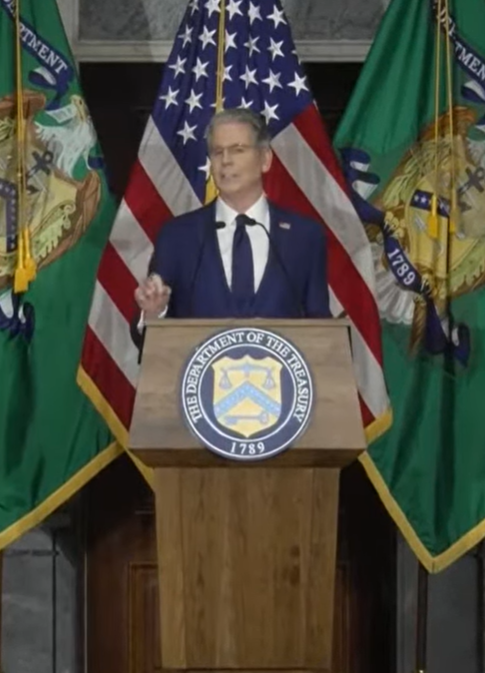
On Wednesday, September 23rd, every Iranian airline on the planet stops flying. Not because of mechanical failures, not because of weather, and not because the UN Security Council spent six months drafting a sternly worded resolution. Because Treasury Secretary Scott Bessent went on CNBC and told the world exactly what would happen to anyone who kept doing business with them.
"On September 23rd, all the Iranian airlines, all the Iranian airlines will be shut down around the world," Bessent said. "You cannot provide them with fuel, you cannot provide them with landing services, you cannot sell them tickets, or you will be knocked out of the dollar system."
That last part is the kill shot. The dollar system isn't a suggestion. It's the circulatory system of global commerce, and Bessent just told every fuel supplier, every airport, every ticket vendor on the planet that servicing an Iranian carrier means losing access to the financial infrastructure that makes their own businesses possible. That's not a sanction. That's an ultimatum with a two-day fuse.
The airline shutdown is the latest escalation in Operation Economic Outcast, the comprehensive sanctions campaign the Treasury Department launched last month as part of the administration's maximum pressure strategy on Iran. The operation has already produced results — Treasury sanctioned three banks, including Egypt's second-largest, for funneling $1.8 billion to Tehran through Egyptian financial institutions. Bessent noted that "we've seen enablers throughout the world," and the message is clear: enabling has a price now.
The broader context matters. The U.S. has been engaged in a nearly seven-month confrontation with Iran involving naval blockades and airstrikes in the Strait of Hormuz, all aimed at forcing Tehran back to the negotiating table on its nuclear program. Previous administrations treated Iran's economy like a problem you manage. This one treats it like a lever you pull.
Grounding a country's airline fleet through financial pressure rather than military force is the kind of move that doesn't get enough credit for what it actually is: creative coercion. No bombs dropped. No troops deployed. Just the quiet recognition that when you control the global reserve currency, you don't need to ask permission — you set terms. Every airport operator in Dubai, Istanbul, and Doha is now running the same math: is one Iranian carrier worth losing dollar clearing?
The objection from the usual diplomatic corners is that this kind of unilateral economic warfare destabilizes the international order. The same international order that watched Iran funnel $1.8 billion through Egyptian banks without raising a hand. That order was already destabilized. Bessent just made someone pay for it.
Most administrations respond to Iranian provocation with a press conference and a new round of talks. This one responded with Operation Economic Outcast, $1.8 billion in sanctioned money flows, and a two-day countdown clock on an entire national airline system.
The September 23rd deadline gives Iranian carriers and their global partners almost no runway to adjust. That's not an accident. That's the point.