
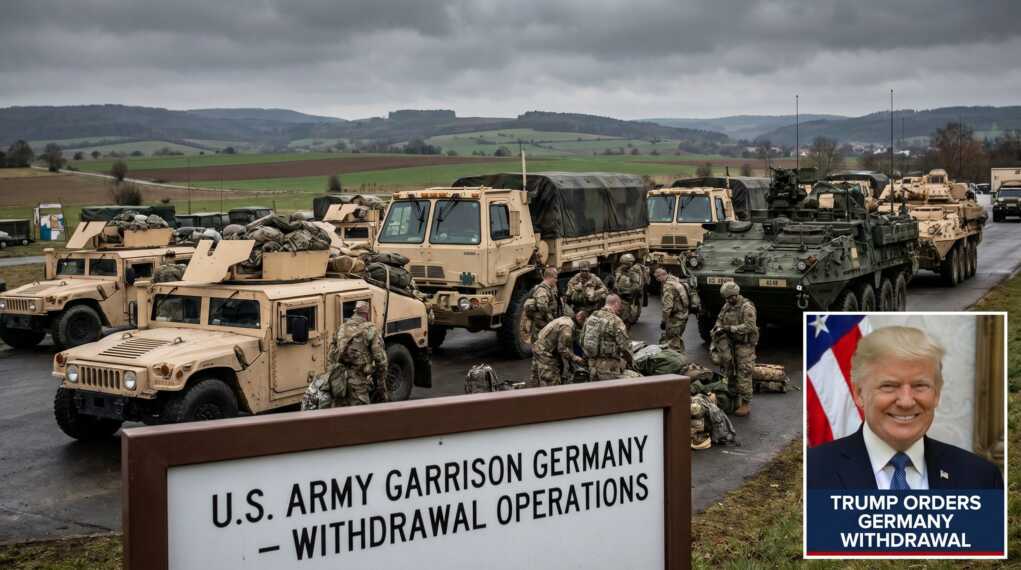
President Trump went full scorched earth on Germany this week, publicly threatening to yank American troops out of the country and calling Chancellor Friedrich Merz “ineffective” while labeling the entire nation “broken.” We’ve got tens of thousands of our boys and girls sitting in Bavaria and Ramstein protecting Europe’s wealthiest economy — a country that can’t even keep its own lights on without Russian gas — and Trump finally said what every American taxpayer has been screaming into the void for decades: why are we still doing this?
But sure, let’s keep 35,000 troops in Germany so their politicians can lecture us about carbon emissions between bites of government-subsidized bratwurst. That seems like a great use of your paycheck.
Here’s the thing that drives the foreign policy establishment absolutely insane about Trump: he treats alliances like business deals. And in this particular deal, we’re the sucker. Germany — the economic engine of Europe, the country that somehow affords universal healthcare and six weeks of paid vacation — has spent decades freeloading off American military protection while barely meeting a fraction of its NATO defense spending commitments. They promised 2% of GDP. They’ve been hovering around 1.5% for years, and even that number is padded with creative accounting that would make an Enron executive blush.
Merz, for his part, is the latest in a long line of German chancellors who talk tough about trans-Atlantic partnerships at summits and then go home and slash their defense budgets. He took over from Olaf Scholz, who took over from Angela Merkel, who spent 16 years making Germany completely dependent on Russian energy while American soldiers stood guard on the eastern flank. It’s like hiring a night watchman and then complaining he’s too loud while you leave all the doors unlocked.
Trump called Germany “broken,” and honestly? Look at the evidence. Their industrial base is hollowing out. Their energy policy is a case study in what happens when you shut down nuclear plants to appease Greenpeace. Their immigration policies have turned entire neighborhoods into no-go zones that police avoid like a vegan avoids a Texas BBQ. And their economy — once the envy of the world — has been flatlining so hard the ECB needs a defibrillator.
But the real story isn’t Germany. It’s the NATO grift that’s been running since the Cold War ended. We won. The Soviet Union collapsed. The Berlin Wall came down. And somehow, 35 years later, we’re still footing the bill like it’s 1985 and the Red Army is about to pour through the Fulda Gap. The threat changed, the world changed, but the American checkbook stayed open.
The Beltway foreign policy crowd — the same geniuses who told us Iraq had WMDs and that Afghanistan would be a quick mission — will clutch their pearls and tell you this “undermines the alliance.” You know what undermines the alliance? One side paying for everything while the other side builds windmills and passes laws about how many genders can fit on a passport.
Let’s talk numbers, because numbers don’t care about your feelings. The United States spends roughly $886 billion a year on defense. Germany spends about $75 billion — and they just recently bumped that up because they finally realized Putin wasn’t bluffing. For decades, American taxpayers subsidized German defense so Germany could spend its money on social programs that American citizens can only dream about. We were literally paying for their butter so they wouldn’t have to choose between butter and guns.
Trump’s threat to pull troops isn’t reckless. It’s leverage. It’s the first president in modern history treating NATO like what it actually is: a mutual defense pact where “mutual” is supposed to mean something. If Germany wants American protection, Germany can pay for American protection. If they don’t want to pay, they can protect themselves. That’s not isolationism. That’s common sense.
The European media is having a collective meltdown, calling Trump “dangerous” and “unpredictable.” Good. Predictability is what got us into this mess. Every president before Trump was so predictable that European leaders knew they could promise defense spending increases at every summit, never deliver, and face zero consequences. Trump is the first guy who showed up at the poker table and actually called their bluff.
Merz can call Trump difficult. Brussels can issue statements about the importance of the alliance. Editorial boards across Europe can write hand-wringing op-eds about American unreliability. But here’s the question none of them want to answer: if American troops left Germany tomorrow, who would fill the gap?
They know the answer. We know the answer. And that’s exactly why Trump holds all the cards.
We’re not the world’s security guard. We’re not Europe’s ATM. And if Germany’s chancellor wants to be taken seriously, he can start by writing a check instead of a press release.