

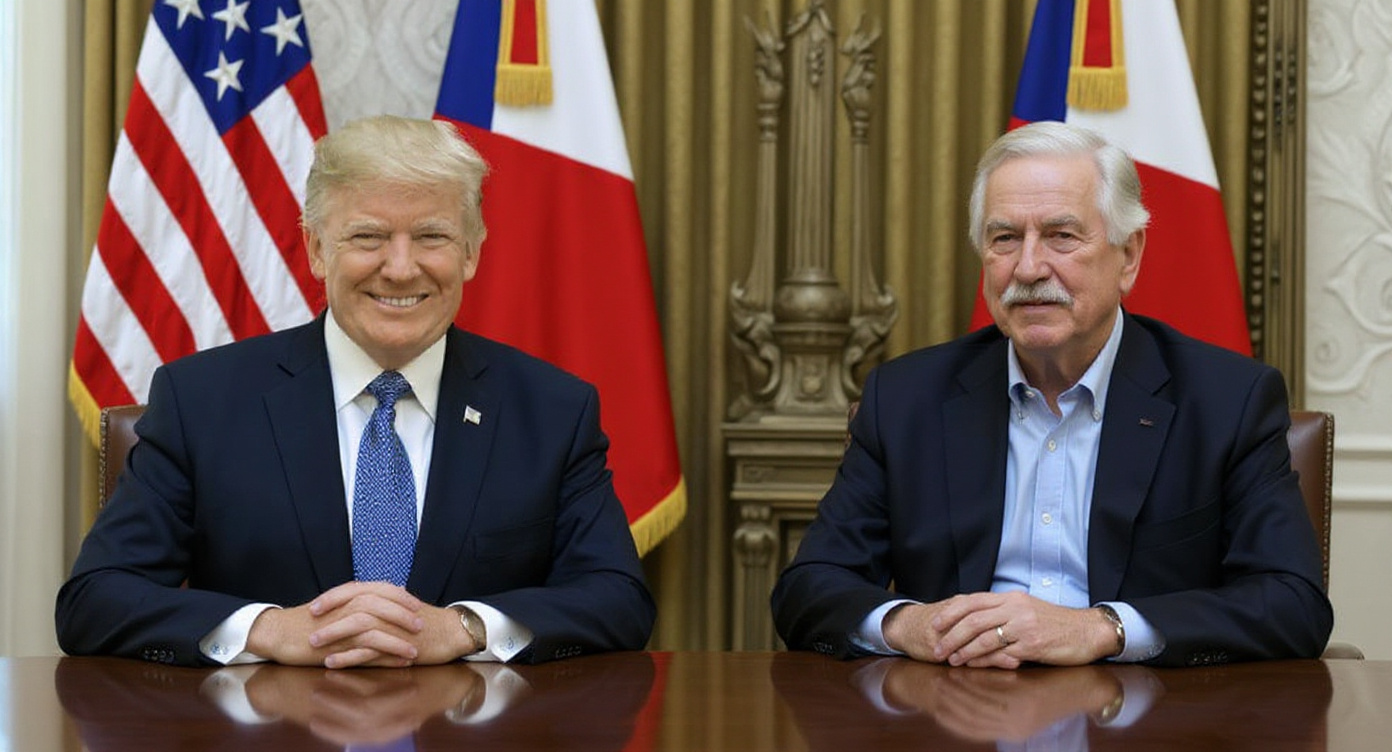
President Trump walked into Malacañang Palace on Wednesday, sat down across from Philippine President Ferdinand Marcos Jr., and by the time the state luncheon plates were cleared, announced the second bilateral trade agreement of his Asia trip in forty-eight hours. "We've just consummated a very big trade deal, the biggest trade deal we've ever made, by far," Trump told reporters at the palace. "And it's a fair deal for both countries."
The day before, it was Thailand. Today, the Philippines. Tomorrow, he flies to Shenzhen to sit across from Xi Jinping and Vladimir Putin.
The Philippines deal, announced during a bilateral meeting in Manila, focuses on two sectors Trump specifically called out: agriculture and energy. "A deal that will be great for our Farmers and those in the business of 'Energy,'" Trump posted, framing the agreement as a direct pipeline for American exports into one of Southeast Asia's fastest-growing economies. The Philippines is currently targeting 1,200 megawatts of nuclear generating capacity by 2032 and 4,800 megawatts by 2050 — and Trump made clear during the meeting that American nuclear technology should be building it. "For the Philippines to embrace American technology in its first modern nuclear project would underscore the strength of the important relationship," he said.
That's not vague diplomatic fluff. That's a president pitching American industry to a foreign leader's face, in his own palace, on camera.
The Thailand agreement, signed one day earlier between Trump and Thai Prime Minister Anutin Charnvirakul, was even more concrete. Thailand committed to purchasing $2.6 billion in additional U.S. agricultural products, eliminating tariffs on American exports, and dropping non-tariff barriers on vehicles, medical devices, pharmaceuticals, ethanol, and poultry. The two leaders signed a "Joint Statement Agreement Between United States of America, the Kingdom of Thailand, on Reciprocal Trade" — the kind of document that gets finalized into a binding deal within weeks, not years.
So the scorecard after two days on the ground: Thailand locked in at $2.6 billion in ag purchases alone, barriers on American cars and drugs coming down. Philippines on board for a broad economic framework covering food and energy, with nuclear cooperation on the table. And Trump hasn't even gotten to the main event yet.
That main event is the trilateral summit in Shenzhen with Xi Jinping and Putin — a meeting that didn't exist six months ago and that the foreign policy establishment said couldn't happen. Trump is arriving with trade wins already banked, which is exactly the kind of leverage that makes the credentialed class uncomfortable. He's not asking for permission. He's showing up with receipts.
Philippine Trade Undersecretary Ceferino Rodolfo indicated the legal framework for the Philippines deal is expected to be signed before the end of 2026. The usual crowd will point to the absence of a signed document on November 18 as evidence that the deal isn't real. Philippine Ambassador to the United States Babes Romualdez confirmed nothing was formally signed during the visit itself. What actually happened is what always happens at this stage of a bilateral negotiation: the two heads of state announced an agreement in principle, and trade officials on both sides now execute the details. That's how the Thailand deal started twenty-four hours earlier, and nobody's questioning whether that one's real.
The broader pattern is worth noticing. Trump's Asia trip was supposed to be about the nuclear talks with Xi and Putin. That's the summit the cable networks have been previewing for weeks. Instead, before he even boards the plane to China, he's already pocketed two trade agreements and met with leaders from Australia, India, and Japan on the margins of the ASEAN summit in Manila.
The man landed in the Philippines on November 17, signed a trade framework with Thailand the same day, announced a second deal with Marcos by lunch on November 18, and flew to Shenzhen that evening. "It took place very quickly and it's a magnificent deal for both," Trump said of the Philippines agreement.
Two countries, two deals, and the week's not half over. The trilateral summit starts Thursday.