

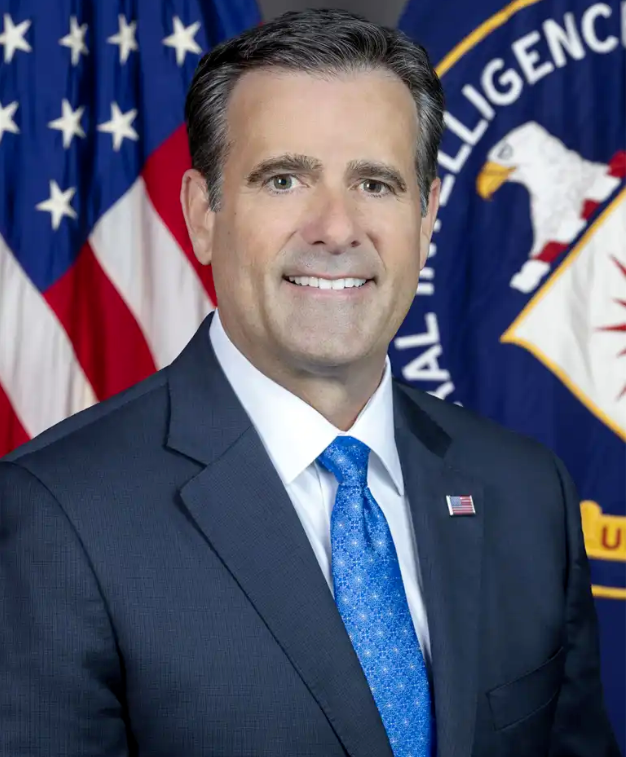
CIA Director John Ratcliffe flew into Moscow on August 25, spent exactly eight hours on the ground, delivered what sources describe as a blunt warning to two of Russia's most powerful intelligence chiefs, and flew back out. Vladimir Putin was supposed to meet him. Putin canceled.
That tells you everything about who's operating from a position of strength right now.
Ratcliffe sat down with SVR Foreign Intelligence Service chief Sergei Naryshkin and FSB director Alexander Bortnikov — the two men who run Russia's entire spy apparatus. According to multiple reports Ratcliffe delivered a message the Kremlin did not want to hear: Russia's military and economic position in Ukraine is deteriorating, and the smart move is to cut a deal before it gets worse.
The CIA director didn't stop at Ukraine. He warned Russia against testing NATO, specifically flagging the Baltic states of Estonia, Latvia, and Lithuania as red lines. U.S. intelligence assessments heading into the trip indicated that Russia's increasingly weak position in Ukraine could tempt Moscow into provocative action against NATO territory — drone incursions into Romania and a missile that crossed into Polish airspace had already put the alliance on edge.
Ratcliffe also pressed Russia to sever its economic and military support for Iran, including cooperation on drone manufacturing and intelligence sharing, as the Trump administration works to financially choke Tehran.
Kremlin spokesperson Dmitry Peskov confirmed the meetings but told reporters that Putin did not sit down with Ratcliffe, saying only that "contacts took place through the intelligence services" and that "of course, President Putin is briefed on everything without delay." A Kremlin-connected source offered a more revealing quote to Agentstvo: "His message sounded as if Zelenskyy was already standing on Poklonnaya Hill looking at the Kremlin through binoculars. Everyone understands that this is not the case."
That's the Kremlin's public spin. Privately, the picture looks different. Ratcliffe floated a trilateral summit between President Trump, Putin, and Ukrainian President Volodymyr Zelensky — an offer to negotiate that Russia hasn't accepted. Putin had initially planned to meet Ratcliffe but pulled out, and three classified presidential decrees were signed during the visit window. Nobody outside the Kremlin knows what's in them.
President Trump, asked about the trip by radio host Glenn Beck, called it "semi-routine" and said he wanted to see the war in Ukraine end, adding that "something may come out of" the visit. Fred Fleitz, former National Security Council chief of staff, said the trip was likely aimed in part at proposing a three-way summit to ease tensions.
The left-wing foreign policy establishment immediately started hand-wringing about whether Ratcliffe was "carrying real policy" or just delivering a message. Steven Cash, a former CIA and DHS intelligence officer now running a group called Steady State, asked publicly, "What policy was Director Ratcliffe actually carrying to Moscow?" Retired CIA operations officer Edward Bogan, who spent 24 years in the field, had a different read: "The fact that a director would get on a plane and come over suggests to me that it was a credible threat." Bogan also noted that Russia "speaks like it has a lot more options than it actually does. If they had such a capability, they would be applying it to the Ukraine fight."
Former CIA chief of station Sean Wiswesser was blunter: "They won't stop till we stop them. So far it has been only unchecked escalation from Russia and failed deterrence."
This was the first visit to Moscow by a sitting CIA director since William Burns traveled there in November 2021, three months before Russia launched its full-scale invasion of Ukraine. Burns went to warn. Russia invaded anyway. Ratcliffe went with something Burns didn't have behind him — a president willing to negotiate from strength and an intelligence community that's been cleaned out of the political operatives who spent four years fabricating Russia collusion narratives instead of doing their jobs.
Putin has responded by intensifying his bombing campaign against Ukraine, believing he can force Kyiv to capitulate on territorial demands by winter. That's the move of a man who got told he's losing and decided to escalate rather than negotiate.
When the other side's response to a diplomatic overture is to bomb harder, it confirms two things: the message landed, and they don't have an answer for it.