

The House passed the budget resolution 216-214. Every single vote mattered. The $95 billion package includes incentives for states to adopt the SAVE America Act — voter ID requirements, proof of citizenship provisions, the kind of baseline election integrity measures that poll at 80% with the general public.
Now it goes to the Senate, where Senate Majority Leader John Thune is busy explaining why things are complicated.
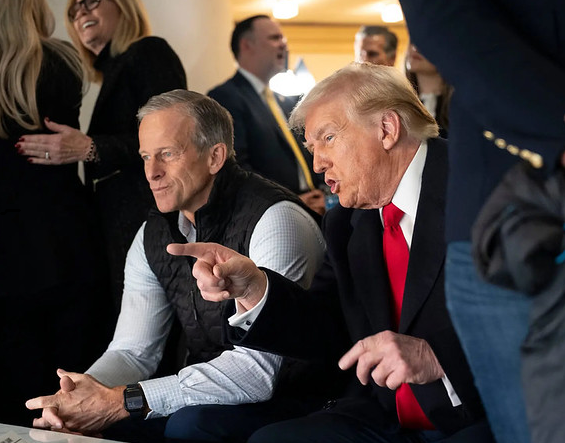
President Trump's message to Thune was four words long and unmistakable: "I'm trying to be nice." That's not diplomacy. That's a countdown timer. And the base heard it exactly the way it was intended.
Thune's recent appearance on Hannity didn't help his case. The Senate Majority Leader used the interview to discuss the filibuster — specifically, why he's reluctant to touch it — and managed to say almost nothing that would reassure the voters who put Republicans in charge of both chambers. The filibuster is a procedural tool. It's useful when you're in the minority. When you hold the majority and the White House and a mandate, clinging to it looks less like principle and more like an excuse not to deliver.
The SAVE America Act isn't some fringe proposal. Voter ID and proof of citizenship for federal elections are supported by overwhelming majorities of Americans across party lines. The House just demonstrated it can get done on razor-thin margins — 216-214, with no room for defection. The question isn't whether the policy is popular. The question is whether the Senate will pass it or hide behind procedural excuses until the window closes.
Thune's position puts him in familiar company. Senators like Susan Collins and Thom Tillis have been name-checked as potential holdouts. Ron Johnson has weighed in on the broader budget fight. The dynamics mirror every major legislative push of the Trump era — the House does the hard work, the Senate stalls, and leadership frames inaction as strategy.
What makes this round different is the leverage. Trump isn't lobbying from the outside anymore. He's in the White House with a fresh mandate and a base that remembers exactly which Republicans slow-walked his first-term agenda. Vice President JD Vance sits as president of the Senate, ready to break ties. The pieces are in place. The only variable is whether Thune decides to move or gets moved.
The Hannity interview was supposed to be a friendly venue — soft lighting, sympathetic host, a chance to explain the Senate's deliberative process. Instead, it became exhibit A for why the base doesn't trust leadership to deliver. When your explanation for delay sounds identical regardless of whether you hold one chamber or all three, the explanation stops being convincing.
Trump has been through this before. He watched Mitch McConnell run the same playbook — express support, raise procedural concerns, let the clock run out, blame the calendar. The "I'm trying to be nice" line is a signal that he's not watching it twice.
A two-vote margin in the House means 216 members found a way to yes under maximum pressure. The Senate has 53 Republicans. If the upper chamber can't match what the House did with less margin, the filibuster isn't the obstacle. The will is.