

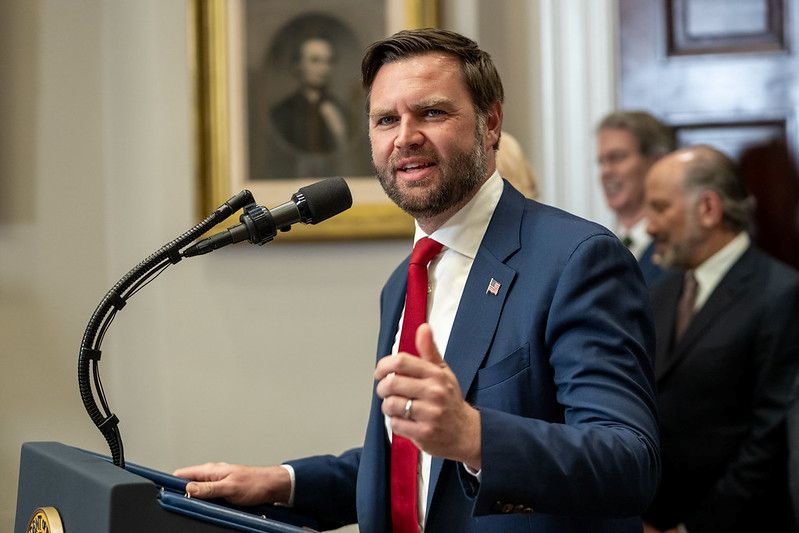
Somewhere over Florida aboard Air Force Two, Vice President JD Vance looked an NBC News reporter in the eye and delivered the most surgically precise political shiv of the midterm season. "It is really obvious to me that, at this very moment, Ted Cruz is running for president," Vance said. Then the kicker: "At this moment, I'm not."
Wow. Those are fighting words.
Vance, 42, had just wrapped a rally at Lakeland Linder International Airport stumping for Rep. Byron Donalds' gubernatorial run and Sen. Ashley Moody's re-election — the kind of grunt work a vice president does when November is 35 days out and the party needs every seat it can hold. The midterm math is brutal and Vance knows it. "Historically there's always a bit of an uphill climb," he told NBC News, "and I think you definitely sense that."
He's not wrong about the climb. The party that holds the White House, the Senate, and the House has a losing record in midterms stretching back decades. Vance said it plainly: "It's always going to be hard to win a midterm when you have the White House, the Senate and the House." After 18 months of unified Republican government, voter impatience over gas prices gives Democrats an opening they haven't earned but will absolutely exploit.
Here's what separates Vance from every other Republican eyeing 2028: he's running the midterm campaign like a general election candidate without ever saying the words. A week before the Air Force Two interview, he was in North Carolina campaigning for Republican Senate nominee Michael Whatley — a state President Trump carried three times but where Democrats haven't won a Senate race since 2008. Two days before that, he sat down with Greg Kelly on Newsmax and framed the entire midterm argument in two sentences: "Don't give power to the crazy people who started these problems in the first place." Then, without missing a beat: "We've made a lot of progress, but we've got to make more progress over the next couple of years."
That's not a vice president reading talking points. That's a future candidate building a record of showing up.
The Cruz contrast makes it sharper. While Vance was doing the party's heavy lifting in swing-state rallies and Senate fundraisers, Cruz was making conspicuous appearances in Iowa and South Carolina — early primary states that have nothing to do with the November 3 midterms and everything to do with a presidential campaign he's pretending he hasn't launched. Vance noticed. Everyone noticed.
"You make these decisions by collecting as much information and trying to make a wise decision," Vance said about his 2028 timeline. "Regardless of what happens over the next 35 days, there will be new information, new things you have to make a decision over." Translation: the midterm results are an audition — not for Vance, but for the Republican Party. He wants to know if we can hold the line before he decides whether to lead the charge.
The political class treats this like a mystery. Will he run? When will he announce? But the answer has been obvious since Vance started treating every campaign stop like he was running already. He's acknowledging what voters actually feel — "If you're frustrated about high prices, you have every reason to be frustrated" — while making the case that returning Democrats to power would reverse everything gained. That's the 2028 pitch dressed in midterm clothes.
Cruz, meanwhile, is campaigning in states that don't vote for another two years while Vance is campaigning in states that vote in five weeks.
One of them is running for president. The other one is going to be president.